
2026 President’s Prize (College level) Winner
Alice Stueck, Centre of Geographic Sciences (COGS) – “Decline: Arctic Sea Ice 1979-2026”
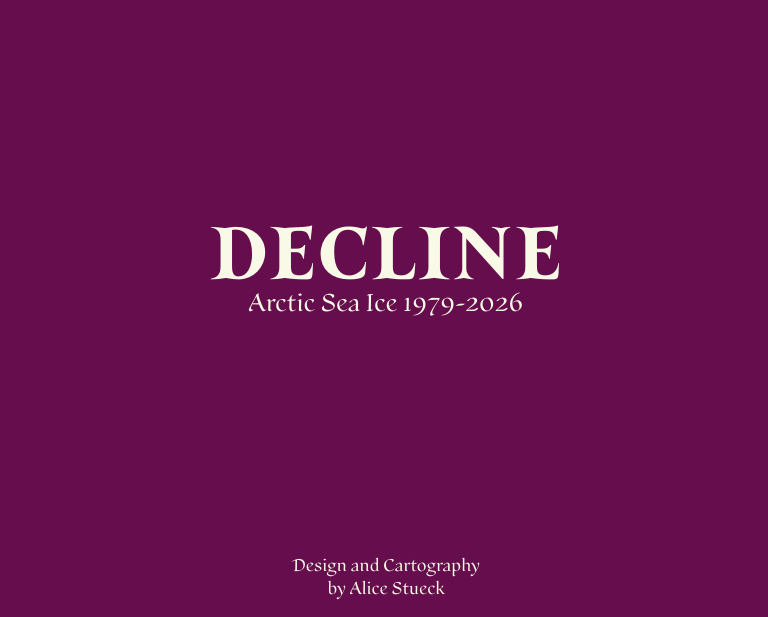 The goal of this project was to represent the decline of Arctic sea ice as shown in NSIDC satellite records in an artistic but easy to understand manner. The final book product will print the ice plates on translucent vellum paper, allowing the reader to compare and contrast and easily understand the change over time.
The ice plate data was sourced from NSIDC satellite records, downloading shapefiles for the maximum extent (March) and the minimum extent (September) for each available year. The polygons for maximum and the lines for minimum were lightly processed for a more natural look, grouped into five year time periods, and arranged in order of size within that group.
The colour schemes for the ice plates were inspired by Impressionist paintings, which often represent snow and ice in pastel or light pinks, blues, and purples.
The printed book (displayed at the 2026 CCA Conference) has gatefold covers allowing the base map and the legend to be moved throughout the different ice plates, to help understand the data on each page.
For this upload, I combined all the pages into the final book layout. In the printed version, the ice plates would be printed on translucent vellum paper, and the other pages on normal paper.
2026 President’s Prize (University level) Winner
Riza Jayawickrema, Universite de Montreal – “Impact of Erosion on Archaeological Site Formation”
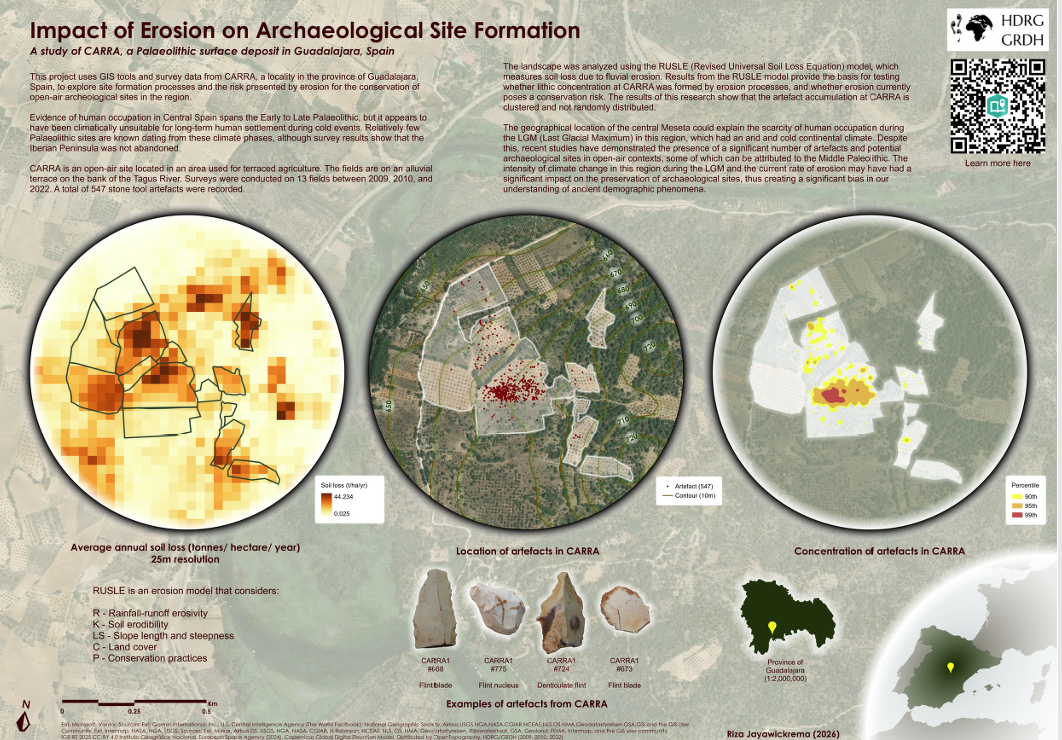
This map is about the research done on the risk of erosion on a Paleolithic archology site in Central Spain. It is a companion piece to a StoryMap that describes the context, methods, and results of the analysis. The map was made using ArcGIS Pro 3.6 and is in the projection WKID:3035 – ETRS89 (European Terrestrial Reference System 1989) LAEA (Lambert Azimuthal Equal Area). The inset map of Spain in the lower right corner is a customized orthographic projection based on “The World from Space” WKID:37008.
I decided to make the map a triptych of the same extent to highlight the 3 ways I interpreted the site; using lithic analysis, spatial statistics, and an erosion model. I chose to keep an imagery background aligned with the center artefact localization map to show the viewer what type of terrain and climate the sites are in.
This project uses spatial analysis and site formation processes to determine if artefact concentrations are caused by erosion.
The results presented here quantify the impact of climate change and erosive agricultural activities on the conservation of archaeological sites. In this sense, the results address many contemporary issues related to the preservation of endangered heritage. As climate change intensifies, intense weather events will increase and create more risk for the conservation of cultural resource sites. The methods explored here could help future archaeologists plan surveys and assess sites in vulnerable areas.
2026 Web Map Award Winner
Ulysses Cyrus Kamps, University of British Columbia – “Street Name Stories of North End Halifax“
https://gonorthstreetstories.netlify.app/
Objectives
This web map was made for the North End Business Association of Halifax (NEBA) in my position as a Community Planning Intern in the summer of 2025. North End Halifax has a rich and complex history, including its decimation and subsequent rebuilding after the Halifax Explosion of 1917. Like every neighbourhood, the stories of the North End have become riddled into the names of its streets. However, these names are now so deeply embedded in the day-to-day vernacular of the city that their origin is scarcely considered.
The objective for this web map was to bring people closer to the histories of the streets they walk down every day and the stories of the people who once lived there. Plaques, monuments and commemorative markers are expensive and unwieldy ways to communicate information. Digital tools offer potentially far greater reach at a fraction of the cost. After the web map was made, QR codes linking to the map were placed around the North End. As of May 7, 2026, more than 2,000 people have visited the site.
Design
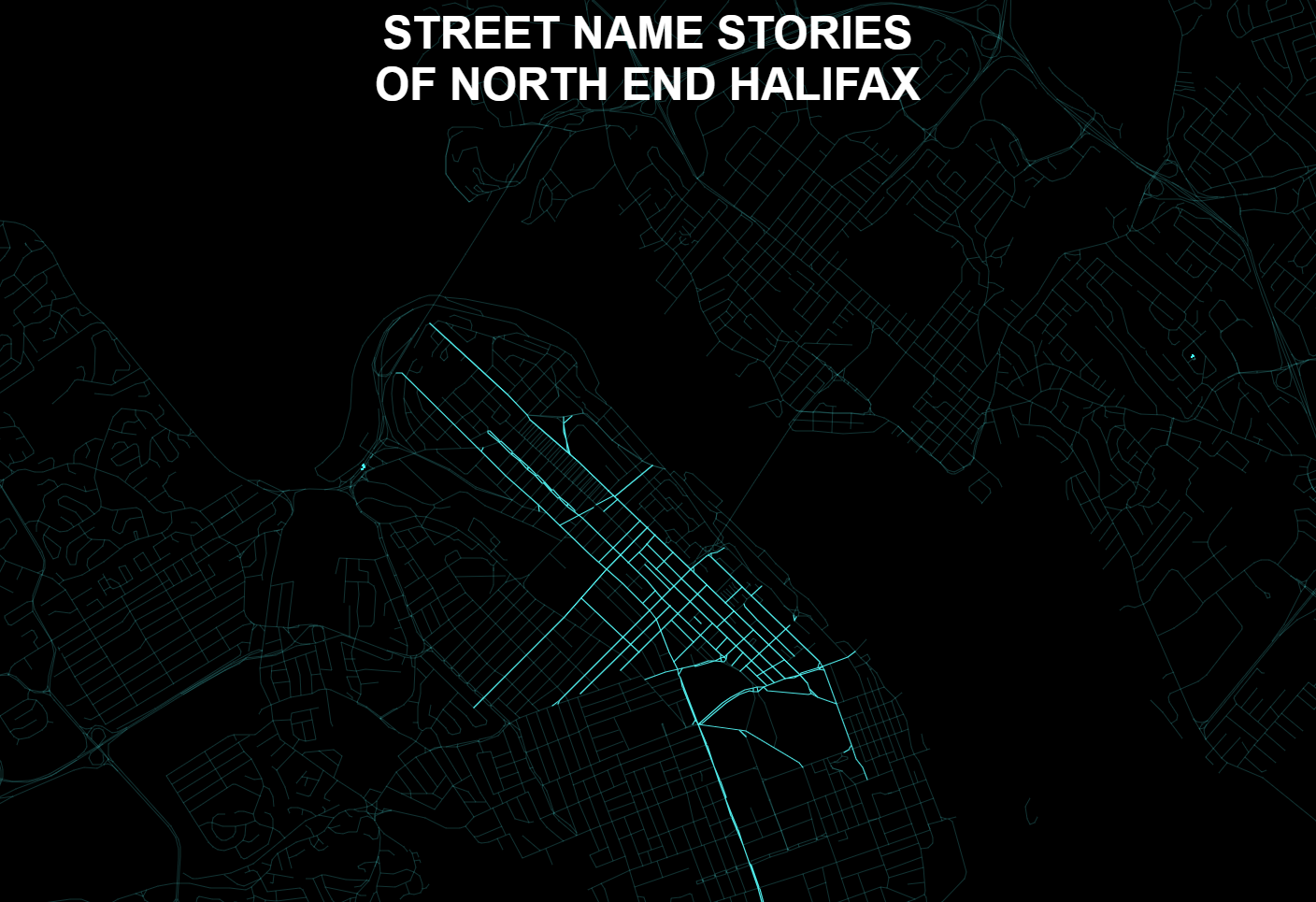
This tool is designed to be simple and intuitive. The map itself has a minimalist layout, with only the street grid to show the shape of Halifax. Streets are the sole focus of this tool and therefore no other landmarks are given. A user clicks on a street and information about that street becomes available to view through a panel at the bottom of the webpage. Each street has a story, taken directly from either a primary or secondary source, accompanied by a historical photograph of the street. Rather than trying to write the histories myself, I wanted to let the voices of the past speak for themselves. The goal of this project was not to write a history of the North End’s streets but rather to put people in touch with the past in a direct and unfiltered way. At the time of its making, I could not find information about every street in the North End. Some streets are missing either a photo or a story.
Methods
The street centreline data for the web map was sourced from Halifax Open Data and is displayed using leaflet.js. The website has a very simple structure with no backend: simply HTML, CSS and JavaScript. Most of the historical information, including photos and text, were taken from the Nova Scotia Provincial Archives or the Halifax Municipal Archives. A few secondary source histories of Halifax were used to supplement where primary accounts were not available. I spent many hours at the archives combing through old newspapers on microfilm. My hope is to return to the archives soon and expand this web map to encompass all of Halifax’s streets.
No awards were given for “Best post-secondary student paper/presentation” at the 2026 conference or for the 2026 Carto-Québec Prize competition.
Thank you to everyone who submitted a map to the competition or presented their cartographic work.

